
Getting 30 yards closer sounds like progress. Between 100 and 70 yards, it can be almost all risk and very little reward.
Every golfer has heard the rule:
Get the ball as close to the green as possible.
It is a good rule. But it’s incomplete.
The real goal is not to get closer, it’s to lower your expected score.
Usually, those two things go together. But there is one important stretch of the golf course where they begin to separate: the partial-wedge zone between roughly 70 and 100 yards.
At the PGA Tour level, expected scoring barely improves across those 30 yards. A player can move the ball from 100 yards to 70 yards and gain surprisingly little on the next shot.
But getting there might require two or three more clubs. It might bring a bunker into range, narrow the landing area or turn a comfortable layup into a shot that flirts with water, rough or out of bounds.
More risk. Almost no reward.
That is why these may be the least valuable 30 yards in golf.
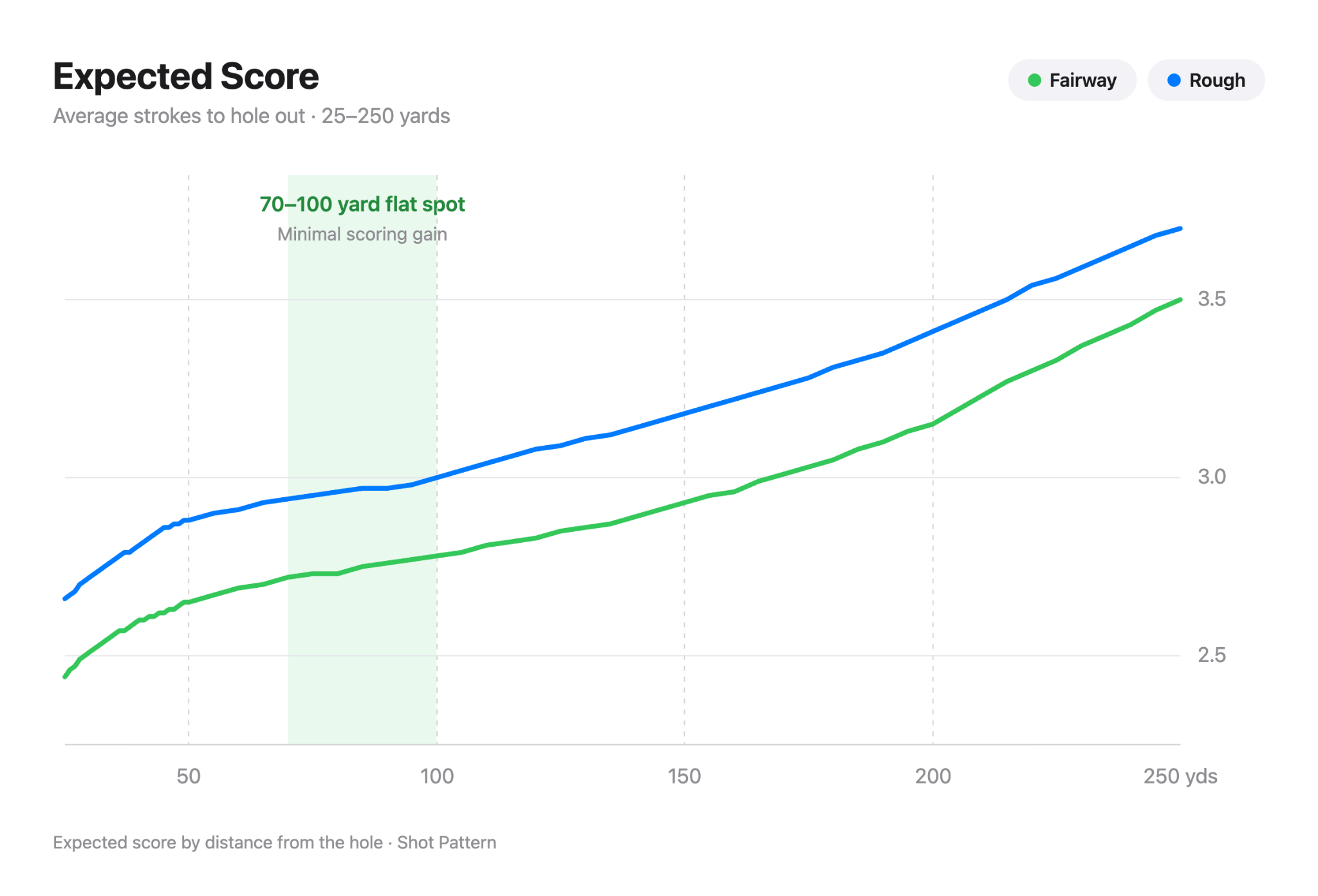 Expected strokes generally improve as a player gets closer to the hole, but the improvement flattens noticeably in the partial-wedge range.
Because of the shape of this curve, every PGA Tour analytics and strategy coach I’ve talked to cautions players against taking extra risk to get the ball 30 yards closer in this area. I’d been staring at the tables and saw that expected score continually decreased as you got closer, but I’d missed the “flattening” that happened in this area. For a stats nerd like me, this was hidden gold.
But as I continued to build Shot Pattern and understand my own game, things got even more interesting.
I recently had a coaching call with Chris Petefish of Course of Action Golf. Chris played three seasons on the Korn Ferry Tour, competed in the 2024 U.S. Open, and was ranked inside the top 300 in the Official World Golf Rankings. His entire coaching practice is built around strokes gained analysis and course management. I wanted to sit down with someone at that level and dig through my Shot Pattern data to see what a professional would notice about my game. Guess what he found?
From 100-145 yards, more than 60% my shots finish within 8% of the start distance. Solidly scratch performance with a wedge in my hands.
From 50-80 yards, that number drops to 33%. Worse, nearly 70% of my shots finished more than 10% of the start distance from the hole.
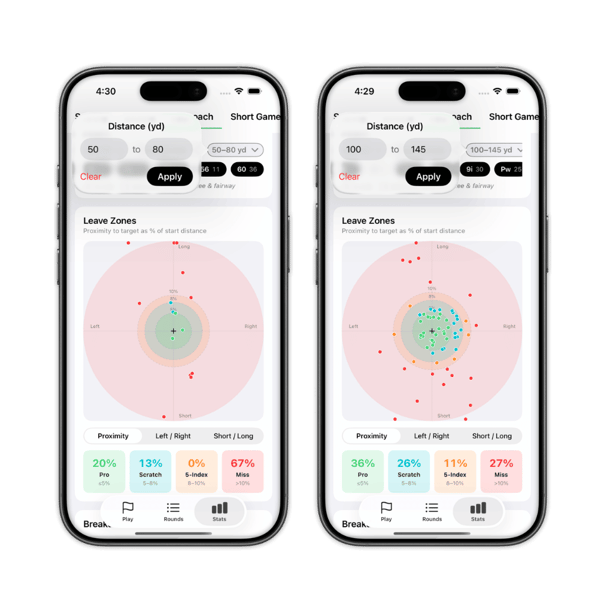
The data is clear: I have a partial wedges problem.
With this data in hand, I have two clear action items:
- Don’t force layups into the 50-80 yard zone. For me, this is where the gains are very minimal. I’m not actively avoiding these spots with fear (a bad shot from 60 yards finishes 25 feet from the hole. A bad shot from 120 finishes 45 feet from the hole.), I’m just really cognizant about how little I stand to gain by pushing the ball here. The shot to get into this zone should not feel like it adds any risk vs. hitting it to 100.
- Work on my partial wedges! (with a caveat) Clearly, I’ve got some work to do in this area. However, as I look at where most of my approach shots come from, this is the area where I hit the least shots of any approach distance bucket. In the last 20 rounds, I’ve hit 21 shots from the fairway and rough between 50-75 yards. This deserves a little practice time, but since I only expect to hit 1 shot a round here, getting really good here is unlikely to make a huge difference in my scoring average. I’m not going to overdo it.
Your least valuable yards may be somewhere else.
The 70-to-100-yard flat spot is useful as a general benchmark. It is not a universal prescription.
Your own scoring curve may flatten in a different range.
What This Changes on the Course
Consider a short par 4.
Driver may leave 65 yards, but it also brings a penalty area or a narrow section of the hole into play. A shorter club may leave 100 yards from a much wider landing area.
The aggressive option is 35 yards closer.
But what are those 35 yards actually buying?
If your scoring expectation from 65 yards is barely better than it is from 100 the aggressive play may be a high risk shot with no real upside
The same calculation applies to second shots on par 5’s.
Before you reach for the longer club, answer three questions:
- Can I get all the way greenside without bringing serious trouble into my normal dispersion?
When the answer is yes, advancing the ball is usually valuable. - If I cannot get greenside, how much scoring value do the extra yards actually create?
Do not assume that 30 yards closer means a dramatically easier next shot. - What does my own data say?
Your strongest wedge range may be different from the Tour average—or different from the golfer standing next to you.
Check out this post for more on the pre-round planning process.
Find the Flat Spot in Your Game
Open Shot Pattern and go to:
Stats → Approach → Proximity by Distance
Look at your performance by different benchmarks. Look at how your performance changes across various starting distances. Look at where you typically have the most approach shots. If, as you get inside 100 yards, your performance starts to degrade, it’s a sign to look further into your data.
Remember that everything is expressed as a percentage of start distance, so even though you may see more orange and red at a shorter bucket, the ball may still be closer to your target than if you were 50 yards further away. It’s just a sign that your proximity is leveling off as you get closer to the hole.
See this post for a full walkthrough of my recommended post-round review process.
Closing Thought: Stop Paying Full Price for Cheap Yards
Golf rewards distance, but it does not reward every yard equally.
Sometimes the best play is to get as close as possible. Sometimes the best play is to stop just short of a high-risk shot that buys almost nothing.
The goal is not to finish every swing closer to the hole.
The goal is to choose the route that produces the lowest expected score.
So the next time you are tempted to hit two or three more clubs just to squeeze another 30 yards out of a layup, ask one question:
What am I actually buying?
Because sometimes the smartest way to add 30 yards to your game is knowing when 30 yards are worth almost nothing.