
Years ago, my best friend looked at me after a round and said, "I think you just need to get better with your wedges."
I was flummoxed. Nothing about the round screamed wedges to me. But he'd watched every shot, and he'd seen something I couldn't see about my own game.
It took me a while to admit it, but he was right. My wedges were a liability. I was no more accurate from 100 yards than I was from 130. I'd spent two years really not knowing what to work on and not getting any better as a result. Without dispersion and strokes gained data at my fingertips, I just couldn't see it.
I later dug into this pattern with a Korn Ferry Tour coach and the data told a clearer story.
Once I finally had those tools, the first thing the data showed me was that I'd been overcomplicating the diagnosis.
As much as I love finding an edge with better strategy, a lot of your bad shots come down to a skill issue. It sucks to hear, but sometimes you're just not good enough (yet).
In my experience, every costly shot on the golf course falls into one of four categories: a skill issue, a strategy issue, a mental or process issue, or simply a hard shot. Each one has a different fix, and confusing them means spending your practice time on the wrong thing.
After a bad round, most golfers already know what they want to work on. The problem is they're usually wrong about what actually went wrong.
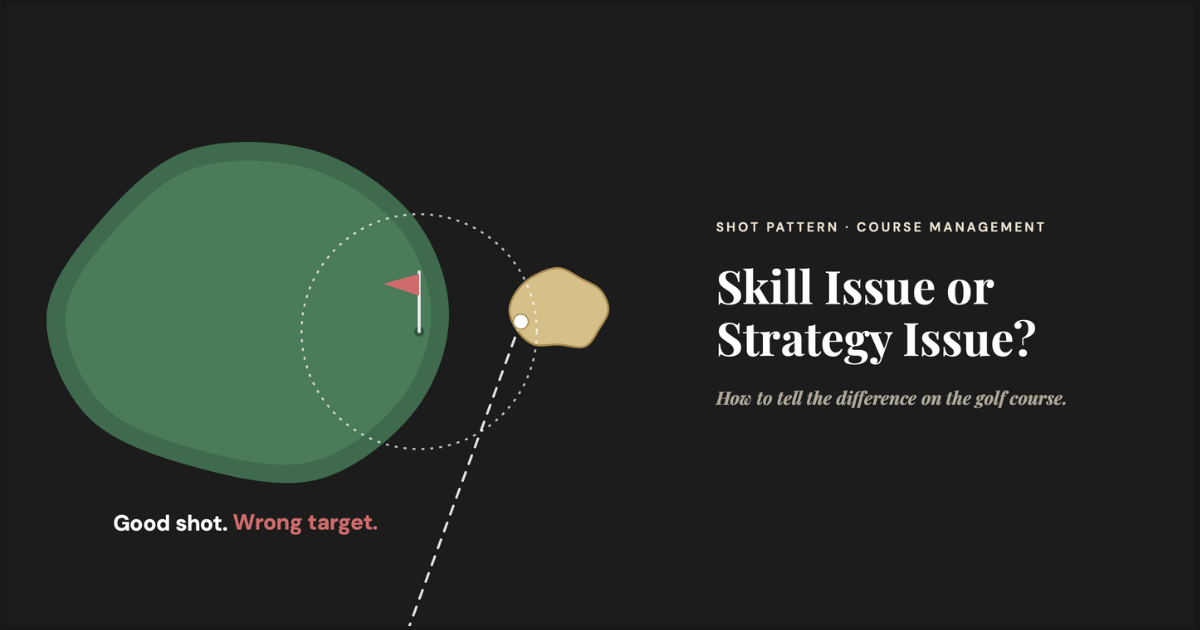
Here's what I mean. You're 150 yards out. You hit your approach and the ball finishes seven yards from where you aimed. By any reasonable standard, that's a quality golf shot. Except you're in a bunker, and from that bunker, you're almost certainly going to lose strokes.
The swing did its job. The ball went where you pointed it. The problem was where you pointed it. That's not a swing problem. That's a target problem. And no amount of range time fixes a bad target.
In my last post I walked through how to review your round and find the three to five shots that cost you the most strokes.
This post is the next step. Once you've found those shots, here's how to figure out what actually went wrong.
Skill Issues:
A skill issue means the swing failed. You had the right plan, you aimed at the right target, and the ball just didn't go where you intended. The question is how far offline is too far. Here are the benchmarks I use, broken down by shot category.
Off the Tee:
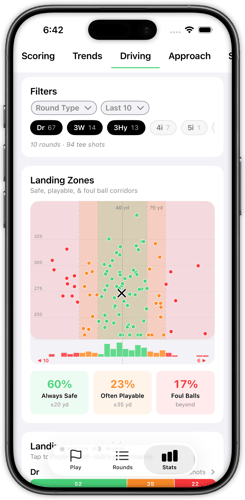
PGA Tour players generally keep their drives within a 65 yard window. As you spend more time measuring courses, you'll notice that almost every layout gives you a driving corridor of 65-70 yards between penalty areas and dense trees. That makes it a practical benchmark regardless of your handicap.
If you miss more than 35 yards from your target off the tee, you're going to be punished on nearly any course you play. Consider anything beyond 35 yards offline to be a skill issue. If you want a deeper look at how dispersion works and why it matters more than distance, we cover that in a separate post.
Approach Shots:
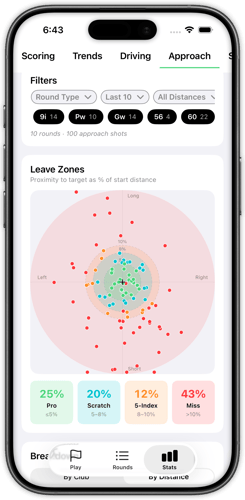 Approaches have more nuance depending on handicap. The way to think about it is your ability to get the ball within a certain percentage of the distance you're hitting from.
PGA Tour players sit at a median proximity of about 5% of start distance.
Scratch players around 8%.
Five handicaps around 10%.
I wouldn't expand the benchmark beyond 10% for higher handicaps. At some point, missing by more than 10% of the distance you're hitting from is a technique issue regardless of skill level.
To put real numbers on it: on a 100 yard shot, a Tour player wants to finish within 5 yards, roughly 15 feet. A five handicap wants to finish within 10 yards, roughly 30 feet. The image below highlights this difference in how those of different skill levels approach the same shot.
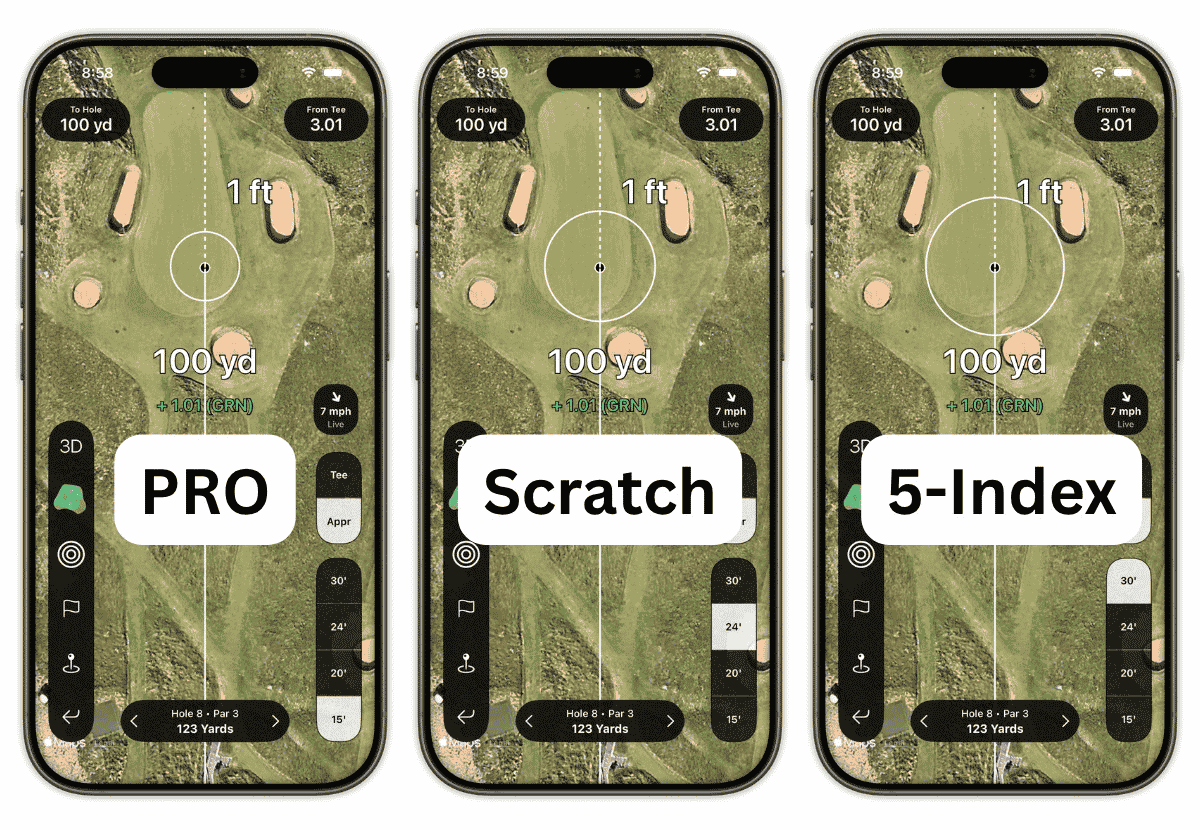 To put real numbers on it: on a 100 yard shot, a Tour player wants to finish
These benchmarks are for shots from the tee and the fairway. From the rough, dispersions get larger in a hurry. It almost becomes a situation where any shot that finishes on the green is a good result.
Around the Green
For shots inside of 20 yards from the hole, here are the proximity benchmarks I use. Anything outside of 20 yards is going to be much more rare to get up and down, so this is the range where short game skill really shows itself.
From 10 yards or closer: inside 5 feet.
From 10 to 20 yards: inside 10 feet. Pros sit around 9 feet.
Putting
Here's what I use for putting:
-
-
Inside 3 feet: make everything.
-
3 to 6 feet: make 75%. (Pros make about 85%).
-
6 to 9 feet: make 50%. (Pros make about 55%).
-
9 to 15 feet: make 25%. (Pros make about 33%).
-
Beyond 15 feet: lag the ball within 10% of the start distance.
-
If you're consistently falling short of these numbers, you have a skill issue in your putting that practice can fix.
Strategy Issues
Almost always, if you're hitting the ball within the benchmarks above but still losing strokes, the problem is your target.
Go back to the 150 yard example. You miss by seven yards and end up in a bunker. From 150 yards, seven yards is under 5% of the start distance. That's Tour quality proximity. But you lost strokes because your target didn't leave room for a miss to end up somewhere safe.
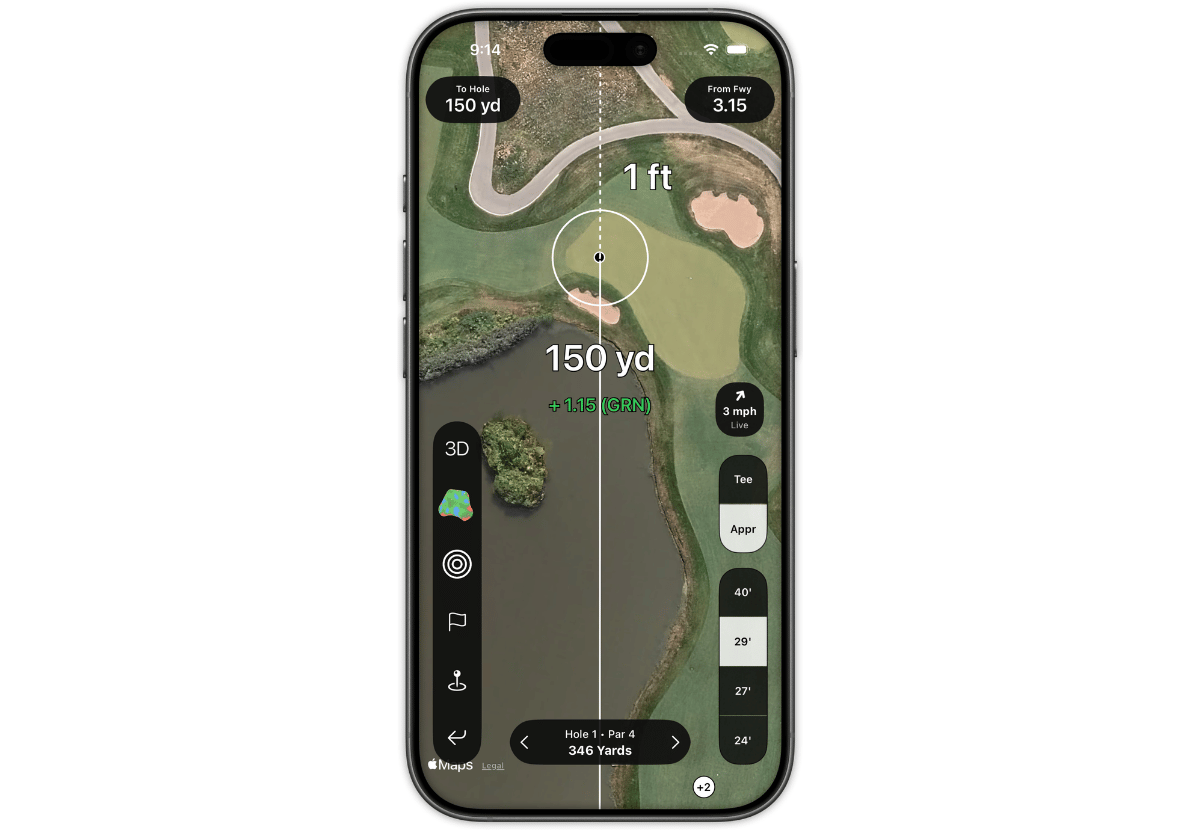 This is where Shot Pattern’s ability to set your intended target and see how far offline you finished becomes important. If you can see that your proximity was fine but your target put you in danger, the fix isn't more range time. It's better aim points. This is where having a game plan built around your actual pattern pays off.
The same logic applies off the tee. If you miss your target by 25 yards but end up in a hazard or out of bounds, you hit a quality tee shot that drew a penalty. That tells you the aim point was too close to trouble, or you were trying to fit your dispersion into a window that was too tight.
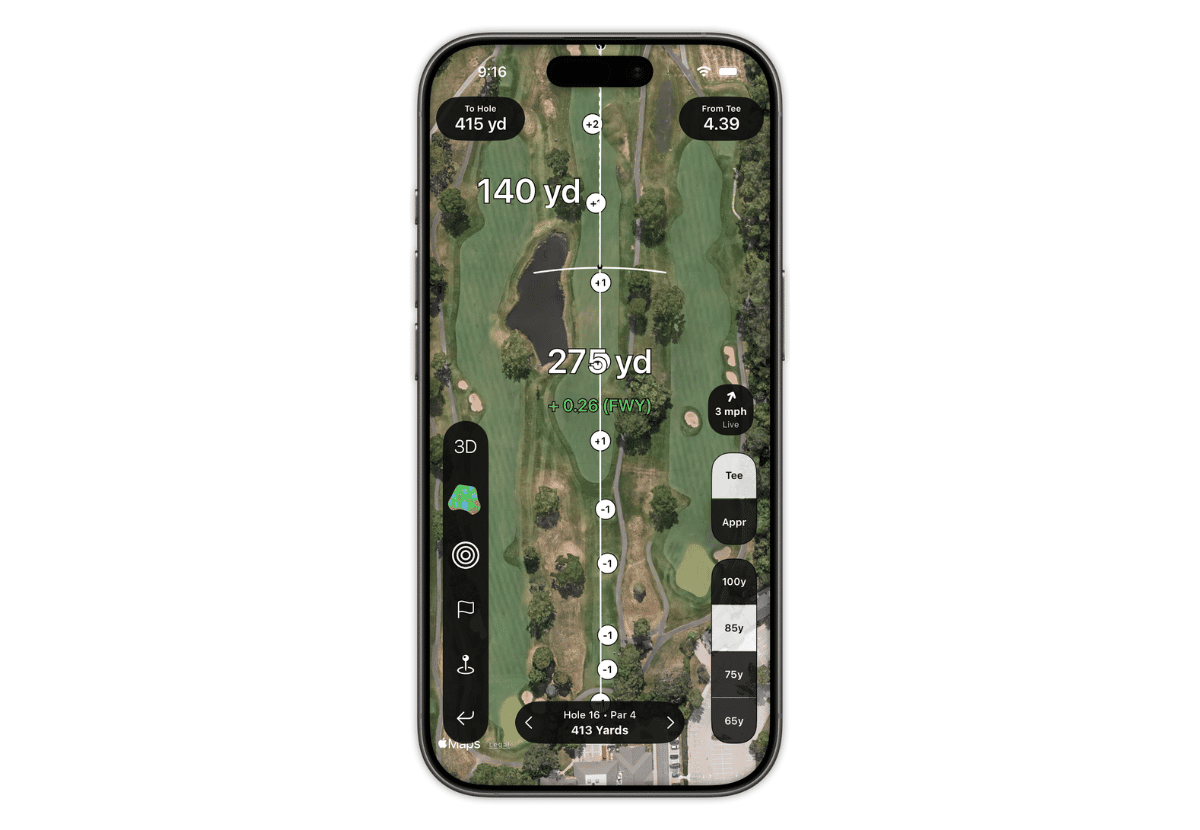
Make sure you're using your approach circles and tee shot arcs during play. They're legal for tournament and handicap rounds, so there's no reason not to use them. When you overlay your actual dispersion on a hole, it becomes clear whether your intended target gives your pattern enough room. If a shot that lands within your normal dispersion ends up in a bunker or hazard, the target needs to move.
Mental and Process Issues
There is so much great content on the mental game from people who have dedicated their careers to it that I'd rather point you to them than try to cover it here.
A mental or process issue means something in your routine or focus broke down. You rushed a shot. You let the last hole follow you to the tee. You didn't fully commit before pulling the trigger. The technique might have been fine. The focus wasn't.
Here are some resources I recommend. Anything by Bob Rotella. The Mental Golf Show with Josh Nichols. Wicked Smart Golf with Michael Leonard. And the Kairo app for visualization and mental training.
Just Plain Hard Shots
Sometimes the outcome was bad because the shot was just hard. The lie was terrible, the wind gusted at the wrong moment, the pin was tucked with no margin for error. Not every bad result is a mistake.
If you try to find a correction for every bad outcome, you'll end up chasing fixes for things that weren't broken. Tip your cap and play the next one. Don't waste energy on things you can't control.
Turn It Into Practice
Once you've sorted your worst shots into these four buckets, the path forward gets specific.
Skill issues go to the range. If you're consistently missing outside your proximity benchmarks from a particular distance or with a particular club, that's your practice target.
Strategy issues don't require hitting a single ball. They require better planning. Spend time in course preview mode with your dispersion overlays and make sure your targets account for your actual pattern.
Mental and process issues require a routine change, not a swing change.
And hard shots don't require anything at all.
Practice time is limited for almost all of us. The golfers who improve fastest are the ones who match the right fix to the right problem. Start by knowing which one you're dealing with, and everything else follows.
If you're looking for specific drills or games to target any of these areas, send me an email. I'm happy to point you in the right direction.
Try Shot Pattern Free for 7 Days