

Author's Note: The printable yardage book feature has seen significant updates since this article was first published. The post below still establishes best practices, but see this post for additional updates.
A pro caddie posted his Q School prep this week. It was simple insight into how pros prepare to compete. Now you can easily print yours.
Drake Smith is a caddie and performance coach - and he’s my new favorite follow on X. (And I say that even though he promotes a product that competes with Shot Pattern.) This week he posted that he and his player were heading to Belgium for DP World Tour Q School, and he attached a screenshot of their text thread.
It's clear Drake went through every hole, estimated where every tee shot would land, and mapped out about how far to expect for approach shots into every hole. It’s not complex, but it’s a skill that separates the competition: Identify what you're going to face, so that you can go practice facing it.
Introducing Your All-New Printed Course Plan
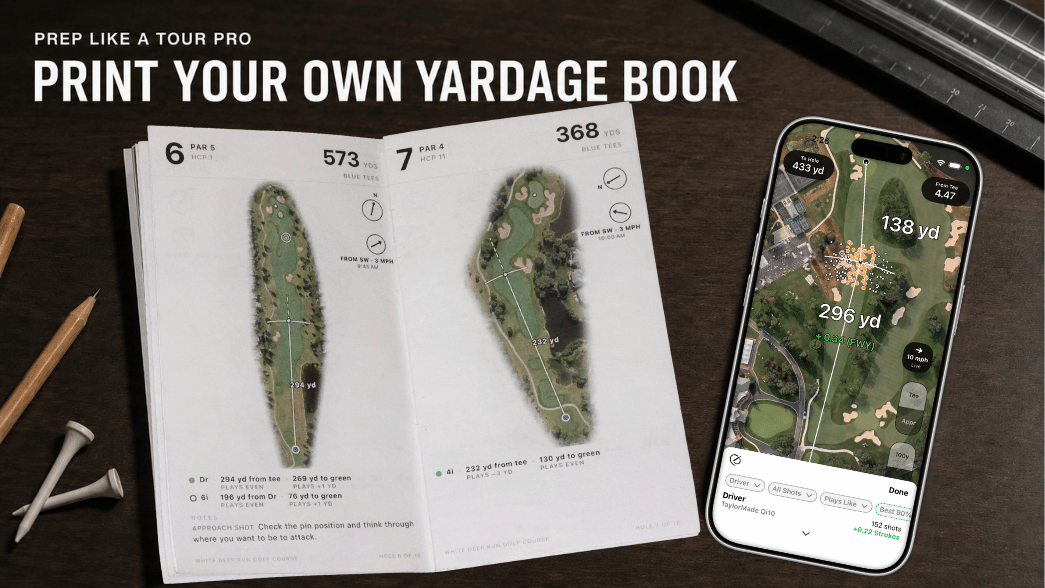
Earlier this week we shipped printable yardage books. Based on the response to this video on Instagram, it's safe to say this feature was long overdue.
You set your targets in Course Preview, tap print, and you get a fold and staple booklet with your own plan inside it. Your saved targets. Your dispersion arcs. The elevation adjustment from your target to the center of the green. The forecasted wind at the time you'll actually be standing on each hole. And whatever notes you wrote yourself.
Shot Pattern exists to give you the data you need to shoot lower scores, and a big part of that is front loading the hard thinking so you can show up and just play. You already know this if you've read anything I've written about pre round prep.
I’ve been asked for years to help people print yardage books. But building a feature to allow people to simply print a yardage book felt like it was missing something to really make it fit the Shot Pattern point of view.
This feature solves for the missing piece: personalization. Shot Pattern books go beyond just a standard yardage book and give you a truly personalized course plan. That course plan starts with an overview of what clubs you can expect to hit that day; all summarized on the first page inside the cover so that you can see exactly how to prepare for your round.
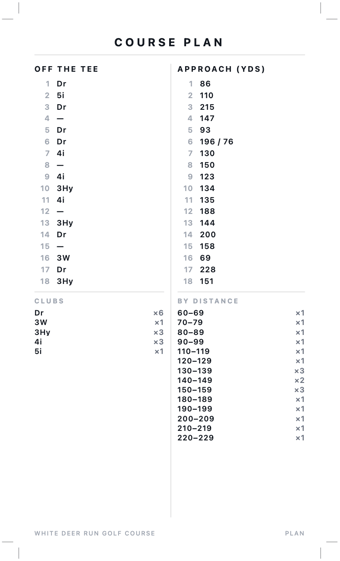
One column lists the club you chose off the tee on all 18 holes. The next column lists the approach distance you'll have if you hit that target. At the bottom, it counts them up by distance bucket.
That page is Drake's text message. It just makes itself as you hit the + TARGET button in the app to indicate your round's intended targets.
Making the Most of Your Course Plan
I think this page inside the cover is absolute gold for your practice session(s) a day or two before the round. Here are three things I'm using this for in my preparation:
-
Most Common Approach Distances: I want to make sure I've gotten a high number of reps in the distances I'm going to see most. In my book above, 130-159 is getting a lion's share of the attention.
- Tee Shot Club Frequency: It's easy to get sucked into pounding drivers on the range. I want to make sure I'm giving my other clubs some reps if I'm playing a course that' s going to take driver out of my hands. In my above course plan, I know I need be ready to hit other clubs, too.
- Awkward Distances: In a recent post titled The Least Valuable 30 Yards in Golf I wrote about how most of us have a "flat spot" in scoring expectations with partial wedges. For me, it was a particularly weak aspect of my game, but not something that happened frequently on the course. In this plan, 4/18 approach shots are going to come inside 100 yards. That means it's getting some attention this week as I prepare.
How to Build Yours
Start in Course Preview Mode in the Shot Pattern App
Everything happens here. Targets, notes, wind, all of it. Pull up your course and give yourself 15 or 20 minutes.
Turn on hole notes before you start
Tap the menu button in the bottom left, tap Tools, and switch the Hole Notes toggle on. Do this first, because it's a lot easier than going back through 18 holes later. There are a few other options in that menu you may not know exist, so poke around while you're in the neighborhood.
Set your tee time
The book works best when you build it shortly before a round. Tap the wind meter to expand it, then tap Select Tee Time. You can pick a tee time up to 7 days out, and the forecast follows you around the course, so the wind printed on the 14th is the wind at the time you're expected to be standing on the 14th.
Wind information like this is permitted under The Rules of Golf, so it can come with you in competition.
Save a target on every par 4 and par 5
Find your target and tap the Plus Target button to record the aim point and the club you plan to hit.
Your target should be where you want the ball to FINISH. Not your start line. The app uses that finish point to calculate the elevation change and to build your approach summary, so a start line in that field quietly corrupts both. If you want to write down a start line, that's a great use of hole notes.
You don't need targets on par 3s or on approach shots into greens. In my opinion, adding those clutters the picture of the hole more than it helps you.
One exception worth making. Add your par 5 layups. If you're likely to lay up on a hole, set a target there. You get the elevation note for the layup, and the layup distance shows up as a number in your approach summary. (That 76 yard shot on 6 I was complaining about earlier only showed up because I set a layup target. Which is either a feature or a personal attack, depending on the day.)
Print it
A color printer that can print double sided is best. Then:
Author's Note: We've upgraded the printing experience since originally publishing this article.
Click here for updated printing instructions.
This is Only Version 1
I know there are details and optimizations we'll add over time. If there's something specific you want in yours, email me and tell me what it is. That's how most of this gets built.
One thing we can't do: green maps don't go in the book. Our terms and conditions with StrackaLine don't allow us to print them, and I'd rather tell you that up front than have you go looking for them at the printer. They are going to provide a discount code to Shot Pattern users if you want to buy a printed book directly from them.
Closing Thought: Do the thinking on the couch
What Drake and his player did before Q School is not out of reach. They wrote down what they expected to face, and then they went and practiced facing it. The only thing standing between that and most amateurs is that nobody hands you the list.
Now something does.
A yardage book doesn't hit a single shot for you. It just means that by the time you're standing over one, you already decided what you were trying to do.
Start your free trial of Shot Pattern and print your first book.