BUY NOW
](https://hubspot-no-cache-na2-prod.s3.amazonaws.com/cta/default/51325885/interactive-382152027853.png)](https://shotpattern.app/hs/cta/wi/redirect?encryptedPayload=AVxigLI2izi9POl2uiWyEnwhpwnM5LtI26Q2AP0p31pnLIHpTg4CuJ%2BCP5%2BrHZbrB4mj%2FbB97Zipf5c96r5BGs8og%2FbBjAEViM2jfLz9t9jaH5Jm4SkvvXmtcGZYOG4rZJdvet3eh1b6G9a8bl6u5mB1W4DFz%2FV5KzjnLAaFD7Ezo5p4H1%2BCOhu0unA%3D&webInteractiveContentId=382152027853&portalId=51325885) 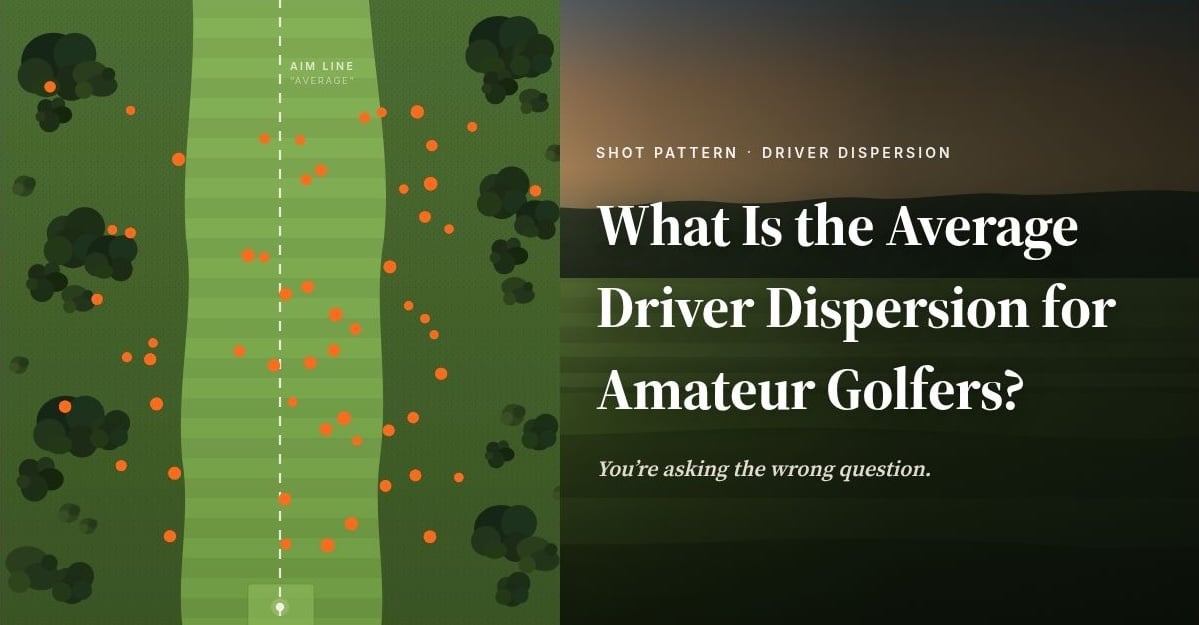 # Average Driver Dispersion: Why Amateurs Ask the Wrong Question  Eric Duffett May 14, 2026 The average driver dispersion for an amateur golfer is roughly 75 to 95 yards wide. But that’s just a number… It won't help you play better golf. That’s because the problem isn't the number itself. The problem is what happens when you try to use an average to make decisions for one specific person. There's actually a perfect illustration of this, and it has nothing to do with golf. In the 1940s, the U.S. Air Force had a problem. Pilots were losing control of their aircraft and crashing at alarming rates, and nobody could figure out why. The planes were fine. The training was fine. The pilots were certain it wasn’t their skills causing the problem either. So what was it? After eliminating all other possibilities, the Air Force finally turned its attention to the cockpit itself, and a decision that had been made nearly 20 years earlier. Back in 1926, a team was tasked with designing the first-ever cockpit. They measured thousands of men across ten physical dimensions: height, weight, arm length, torso size, inseam. Then, they built a cockpit around the perfectly average pilot. By designing a cockpit around the average pilot, they figured they could design something that comfortably fit as many of the pilots in the Air Force as possible. Except, it turned out to be one of the most expensive mistakes in aviation history. Not a single pilot out of thousands actually matched that average profile. By optimizing for the average, they had built something that fit nobody. Todd Rose documented this in his book [The End of Average](https://www.toddrose.com/endofaverage), using it to make a larger point: **average is a useful statistical tool, but it falls apart the moment you try to apply it to an individual.** I’ve noticed that most golfers are still building their game around the aviation equivalent of that first cockpit. In fact, I built Shot Pattern because I ran into this exact problem. When I started developing the app, the only dispersion benchmarks available were from Tour players: a roughly 65-yard-wide cone off the tee. But the reality is that I’m not a Tour pro. At the time, I was a 3 handicap and a high school teacher in the suburbs of Chicago. When I started tracking my own drives, I quickly realized that multiple shots per round were landing well outside the Tour benchmark I'd been using as a reference point. My dispersion looked nothing like the published data, and I had no idea what it was supposed to look like for someone like me. So I started building tools to find out. Three years and more than 100,000 users later, the results have been genuinely surprising. I've found Scratch golfers with dispersions over 100 yards wide. Twelve handicaps with driver dispersion as tight as a professional. Twenty handicaps who can easily hit it 270 yards. Two players at the same handicap index with completely different shot profiles, requiring completely different strategies off the tee. The average driver dispersion for amateur golfers? It doesn't really exist in any useful form. Every golfer's profile is its own thing, and handicap turns out to be a poor predictor of how wide that profile runs. ## **What changes when you know your actual number** Once you have real dispersion data, club selection and target lines stop being guesswork. They become geometry. If your driver cone is 90 yards wide, the advice to “hit driver any time you have 65 yards between penalty hazards” doesn’t apply to you. But knowing that if you aim 45 yards away from the O.B. line, you can essentially eliminate the possibility of a penalty stroke - that’s the kind of data that gives you an edge. Maybe you’re the golfer whose 3-wood is actually far more accurate than your driver, and it becomes your go to club on a tight hole. Maybe you’re the golfer who’s better off keeping the driver in his hands when everyone else is reaching for an iron. Maybe adjusting your aim point another 10 yards away from trouble is all that’s holding you back from cutting a couple easy strokes off your game. Shot Pattern overlays your personal dispersion onto each hole so you can see, before you swing, whether the line you're picturing fits your game. It's the same shift the Air Force made, from a system built around the average to one built around the individual. **The strategy gets sharper because it's yours.** For a step by step walkthrough of how to apply your dispersion data to a specific course, see our guide on [how to create a game plan before your next tournament](https://shotpattern.app/blog/how-to-create-a-game-plan-before-your-next-golf-tournament). 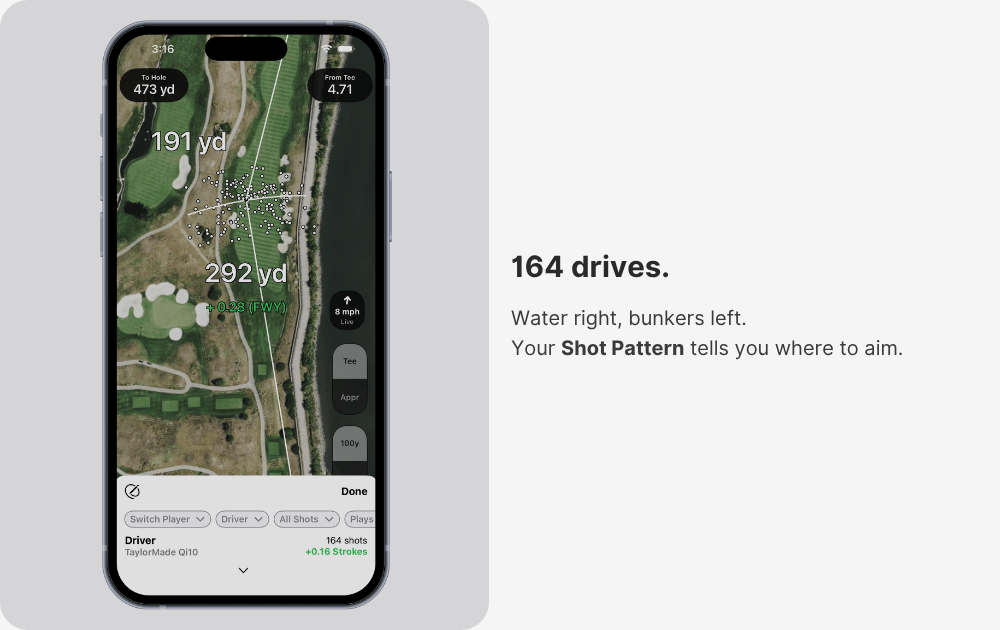 ## How Shot Pattern Builds Your Profile When you first open the app, you'll get a baseline dispersion estimate generated from your handicap index and driving distance. It's a starting point, not a conclusion. As you log rounds, that estimate gets replaced by your actual shot data. The goal is roughly 100 tracked shots per club, which gives you a reliable picture of your real pattern. Some clubs will build data faster than others, and learning which clubs you barely touch is useful information on its own. Shot Pattern supports manual round entry, so if you have recent rounds in memory or logged somewhere else, you can get that data in now without waiting for your next tee time. If you have access to a launch monitor, 20 drives uploaded as a spreadsheet will establish a solid driver baseline faster than anything else. Indoor sessions and range work tend to be more consistent than on-course tracking, which picks up variability from lie, wind, and elevation. The picture forms faster than most golfers expect. Download Shot Pattern and start building yours. [7 Day Trial](https://pay.rev.cat/mwykqkudigbdfshq/$RCAnonymousID:d5faaaaec8cf47a396df7ea1b748ffae/paywall), on me. --- ## Frequently Asked Questions What is the average driver dispersion for amateur golfers? Amateur driver dispersion typically ranges from 75 to 95 yards wide, but the average is misleading. Handicap is a weak predictor of dispersion, and individual variation is enormous. Scratch golfers can have 100-yard dispersions and 12 handicaps can have Tour-tight patterns. The only number that matters for your strategy is your own. How wide is a PGA Tour player's driver dispersion? A PGA Tour player's driver dispersion is typically 65 to 70 yards wide from left to right, according to data analyzed by Mark Broadie and tracked through the PGA Tour's ShotLink system. That figure surprises most amateurs, who assume Tour pros hit it on a string. They don't. They just keep the ball in play more often than they hit the perfect shot. *(Source: [Practical Golf,](https://practical-golf.com/good-golf-shot) citing [Mark Broadie's strokes gained research](https://business.columbia.edu/faculty/research/every-shot-counts-using-revolutionary-strokes-gained-approach-improve-your-golf))* Does a lower handicap mean tighter dispersion? Not reliably. Lower handicap golfers tend to have tighter dispersions on average, but the correlation is weaker than most golfers assume. Shot Pattern's data shows scratch golfers with 100-yard dispersions and mid-handicap players with patterns as tight as professionals. Two players at the same handicap often have completely different shot profiles, which means they need completely different strategies off the tee. How many shots do I need to track to know my real dispersion? About 100 tracked shots per club gives you a reliable picture of your dispersion. You can get a useful working estimate from 20 to 30 shots, especially with a launch monitor where conditions are controlled. On-course data takes longer to build because lie, wind, and elevation introduce variability, but the data is more representative of how you actually play. Most golfers see a clear pattern emerge faster than they expect. What is shot dispersion in golf? Shot dispersion is the spread of where your shots land relative to your target, measured by width (left-to-right) and depth (short-to-long). Every golfer has a dispersion pattern for every club. Understanding yours is the foundation of course management, because it tells you which targets are realistic and which ones bring trouble into play. Dispersion is the data that turns guesswork into geometry. How do I use dispersion to pick a target line? Aim so that your dispersion pattern, not your ideal shot, avoids trouble. If your driver dispersion is 70 yards wide and there's out of bounds on the left, your target line needs to sit at least 35 yards right of the OB so a missed shot stays in play. The best target is the one where every shot in your normal pattern still leaves you a playable next shot. Shot Pattern overlays your personal dispersion onto each hole so you can see this geometry before you swing. For approach shots specifically, understanding the green's contour data is just as important as knowing your dispersion. See our breakdown of [what green maps are actually for](https://shotpattern.app/blog/green-maps-purpose). Is driver always the right club off the tee? No. Driver is only the right club when its dispersion fits the hole. On a tight hole with penalty hazards close to your driver landing zone, a 3-wood or hybrid with a narrower dispersion often produces a better expected score, even though it leaves a longer approach. Mark Broadie's [strokes gained](https://shotpattern.app/blog/what-is-strokes-gained) research in *Every Shot Counts* confirms that distance matters, but keeping the ball in play matters more on holes with severe trouble. Club selection should always be a function of your dispersion versus the geometry of the hole. *(Source: Mark Broadie, Every Shot Counts, Columbia Business School)* Can a launch monitor help me build my dispersion profile faster? Yes, a launch monitor is the fastest way to build a dispersion profile, especially for driver. Twenty controlled drives on a launch monitor like Trackman or GC3 will establish a solid baseline in a single session. Shot Pattern lets you upload launch monitor data as a CSV directly into the app, so range and indoor sessions populate your dispersion patterns the same way on-course tracking does. The tradeoff is that indoor data tends to be tighter than on-course data, since you remove variability from lie, wind, and elevation. ## Share this post