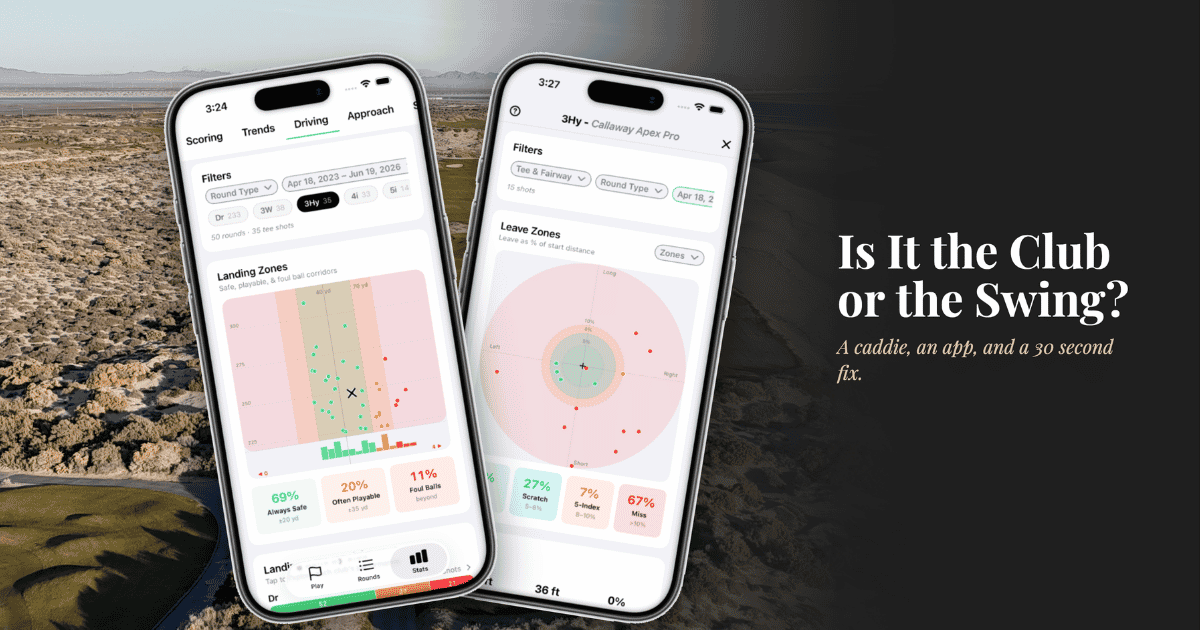


If one club in your bag has a miss pattern that none of your other clubs share, the problem is probably the club, not your swing.
Here's how a caddie, an app, and a 30 second hosel adjustment proved it.
What a Caddie Saw
Meet Derek. Derek is a caddie at Bandon Dunes and does a great job. I met him back in mid June when I was on a trip with my buddy Fred, playing every inch of this beautiful property. About three rounds in, I pulled my hybrid for a tee shot, and Derek told me to aim 30 yards left of where I was looking.
I gave him a puzzled look but didn't say anything. He read my face. "You always miss that club to the right."
We'd only known each other for about 24 hours, and yet here he was telling me I had an extreme bias with my hybrid. I hadn't been playing very well, and the 30 mph winds felt like they were getting the better of me.
I didn't fully trust that Derek knew me and my game. I figured the handful of shots he'd seen were probably an anomaly and some off center hits. I brushed him off, took what I thought was the right target, and of course missed well right of where I wanted the ball to go.
The next day on the range, as I was warming up, I pulled my hybrid and was determined to get the ball to go left. I found myself rounding off my swing and changing away from my standard feels just to force the ball leftward. My first thought was to blame Derek for putting doubt in my head.
What My Data Said
I got home from the trip and went back to my Shot Pattern work. I'd been working on new screens that break down your shot dispersion by club, showing where each club's shots actually land relative to your target. Landing zones, scatter plots, corridor percentages.
As I was testing them with my own data, I pulled up my 3 hybrid and…. There it was.
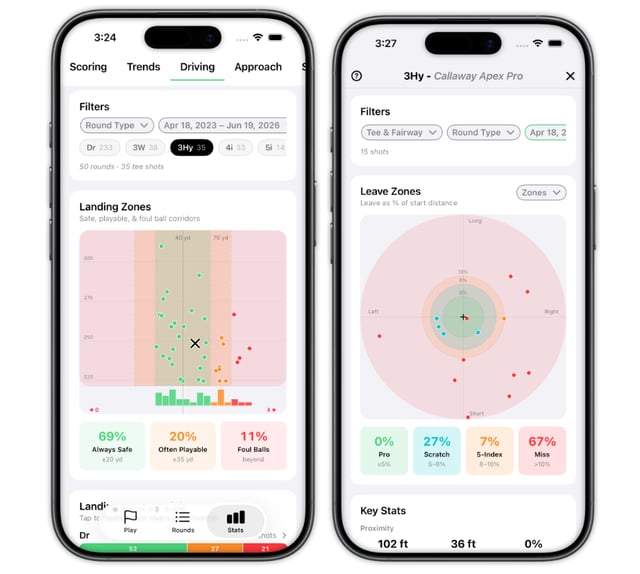
My 3 hybrid had 35 tee shots tracked across 50 rounds, and the picture was unmistakable. A heavy right bias with shots scattered well outside the safe corridor. 69% of my shots landed in the always safe zone (within 20 yards of center), 20% were often playable (within 35 yards), and 11% were foul balls beyond that. The scatter plot told the same story: a cluster of misses skewed to the right that none of my other clubs produced.
I texted Derek immediately. "F'in A, man! You were right! I do miss this thing right!"
I compared the pattern to a bunch of my other clubs, and none of them had this picture. It was unique to the hybrid.
Figuring Out Why
I thought back to when I purchased the hybrid. It was a rushed trip to PGA Superstore where I swung the club a few times, decided I liked the look of it, and put it in the bag straight away.
It was before I knew much about the science and importance of club fitting and how a proper fit can make all the difference. I've always had my irons fitted and thought of it mainly as a height thing (I'm 6'5") more than anything else. But I've always played standard length hybrids and woods. No fitting.
I hopped on ChatGPT and asked some questions. I gave it the context that my irons are an inch long and two degrees upright, that I was missing everything to the right, and the model of my hybrid. I asked whether buying a club off the rack was contributing to my issues, or if I just had a mental block.
Sure enough, a club with too flat of a lie angle will cause the ball to miss right. If your irons are fitted to sit more upright and your hybrid isn't, you're fighting geometry every time you swing it.
The Fix
Before I rushed out to buy a new club, I tried one triage step first. My Callaway Apex hybrid has a two way adjustable hosel. I had always thought that switching it to a draw setting would simply close the face at address, but because of the two way design, the club still looked square. It just made the club more upright, which is exactly what I needed.
I went out to the course with renewed hope that this bugaboo spot in my bag might end up being a super simple fix with technology that was sitting there waiting to be used that I hadn't taken advantage of.
A few practice shots on the range showed signs of promise. The moment of truth came four holes in: a dogleg right with pinching bunkers that took the driver out of my hands. Hybrid was the play. I made the same swing I'd make with any other club and flushed the ball straight down the middle.
It happened four more times that day. A little off the toe, a little off the heel. Everything was still in play. It felt like magic!
I texted Derek in delight. One last gift from an awesome caddie.
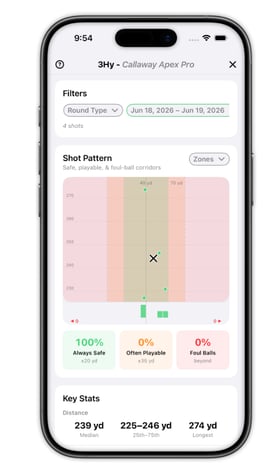
Four hybrid tee shots from that round. All safely in the 40 yard corridor. 100% in the always safe zone. Zero foul balls.
What This Means for You
I know that might have gotten a bit technical. So here's the big takeaway for you, the Shot Pattern user.
There are some screens in the app that will help you see your dispersion and bias with different clubs in a way that makes this kind of diagnosis possible. I'm really excited about what these charts unlock, especially for this exact use case where there might be easy strokes you can take off your game just by identifying a poor club fit.
The diagnostic is simple.
Pull up your club stats in Shot Pattern and look at the Landing Zones view for each club. Pay attention to the scatter plot and the corridor percentages (always safe, often playable, foul balls). What you're looking for is a club that has a bias none of your other clubs share.
If every club in your bag has a pretty even distribution of misses left and right but one club consistently favors one direction, that's your signal to explore a fit adjustment before you go changing your swing.
In my case, every other club in my bag had a balanced spread. Just the hybrid had a right bias. And it was a 30 second fix by adjusting the hosel so that the club sat more upright.
Other fixes might not be as simple, and getting some expert help is definitely recommended. I've had a great experience getting fit for clubs at TrueSpec, and I should have trusted them here rather than just grabbing something off the rack.
They were kind enough to set me up with a 10% discount I can pass along to all of you. When it comes to custom clubs, sometimes 10% off the order is enough to pay for your Shot Pattern subscription for a year or more. If you're in the U.S. or Australia, I encourage you to check them out. Please mention my name (Eric Duffett) if you decide to use the discount, as it helps me make sure I can keep passing it along.
And, of course, if you’re new here don't forget to get your free 7-day trial of Shot Pattern.
ee