---
title: How to Calculate Plays Like Distance in Golf
description: Learn how to calculate plays like distance in golf using simple adjustments for altitude, temperature, elevation, & wind. Simple math, better results.
image: https://shotpattern.app/hubfs/shot-pattern-plays-like-distance-golf-course-management.png
---
[Skip to content](https://shotpattern.app/blog/plays-like-distance#main-content)
[](https://shotpattern.app/)
[How it Works](https://shotpattern.app/features) [Pricing](https://shotpattern.app/pricing) [Blog](https://shotpattern.app/blog)
[](https://shotpattern.app/hs/cta/wi/redirect?encryptedPayload=AVxigLInFWdCWIJn1%2BwgNS8q9yf1bfpJPymmr7uO%2BOATYFdem%2FzEOmrrm0w0Q%2B00BK8VvOcg4v3%2B3LYAEYTfdDGAkNjZXYUTcXQXD9XvYKRo9KM60HBAGpy06BzxvjRvvbwuvh6RgsNBZTpRcGrt6PNrYy7lY14WMm2b78CkaY%2BpqJaoF9IbhMNL260%3D&webInteractiveContentId=382152027853&portalId=51325885)

# How to Calculate Plays Like Distance in Golf

Eric Duffett
June 25, 2026
The yardage on your GPS tells you how far it is to the pin. Plays like distance is how far the shot actually plays once you account for conditions.
Cold air, elevation changes, wind, and altitude all shift that number, sometimes by a full club or more. Each variable comes with a simple rule of thumb you can learn once and run in your head on the course.
I'm a high school teacher. My job was never just to hand students the answer. It was to help them get there themselves, understand why the answer is what it is, and give them the skills to think through problems. That's the part that sticks.
Shot Pattern follows the same philosophy. A lot of golf apps will calculate a plays like number for you, but those features aren't permitted in tournament play or handicap rounds.
I’d rather just teach you to do the math yourself so the skill is yours when the round counts.
**To calculate Plays Like Distance, start with your GPS yardage, then adjust for four things:**
- **Altitude:** add about 1.2% per 1,000 feet above your home course
- **Temperature:** add about 1.5% per 20°F below 70°F
- **Elevation change:** add or subtract about one yard per yard of uphill or downhill
- **Wind:** add about 1% per mph of headwind, subtract about 0.5% per mph of tailwind
Here’s how each works and where the numbers come from.
## **Altitude: Reset Your Bag When You Travel**
Thinner air at altitude means less drag, so every shot carries farther. This is not a shot by shot calculation. It’s a one time reset of your stock yardages when you arrive somewhere new.
**Baseline: about 1.2% more carry per 1,000 feet of elevation gain over your home course.** A sea level player visiting Denver, which sits at roughly 5,000 feet, picks up around 6%. A club that normally carries 150 will carry closer to 159. Because the adjustment is a percentage, your driver gains far more raw yardage than your wedges (which means your [tee shot dispersion](https://shotpattern.app/blog/average-driver-dispersion-wrong-question) at altitude covers more ground than it does at home). Reset every number once when you arrive and play off the new figures for the rest of the trip.
## **Temperature: A Small Adjustment for Ball Flight, a Bigger One for Your Body**
Cold air is denser, which increases drag and causes the ball to fly higher and shorter. A cold ball also compresses less efficiently off the face, which compounds the loss.
**Baseline: work from around 70°F.** Per [Titleist](https://www.titleist.com/learning-lab/performance/temperature-and-golf-ball-performance), you lose roughly 1.5% of carry for every 20°F drop. That works out to about 5 yards on a 300 yard drive between 75° and 55°. Below baseline, add yardage. Above it, take a little off. On its own, temperature is usually the smallest of the four adjustments.
But the air is only part of the story on a cold day. Layering up and playing with muscles that never quite get warm often has a bigger effect on your distance than the temperature itself. There’s no exact rule of thumb for the physical side, but it’s worth knowing that the baselines above account for the air only. When you stack a cold ball, dense air, and a restricted swing, the real world loss can add up to a full club.
## **Elevation Change: The Simplest Adjustment**
**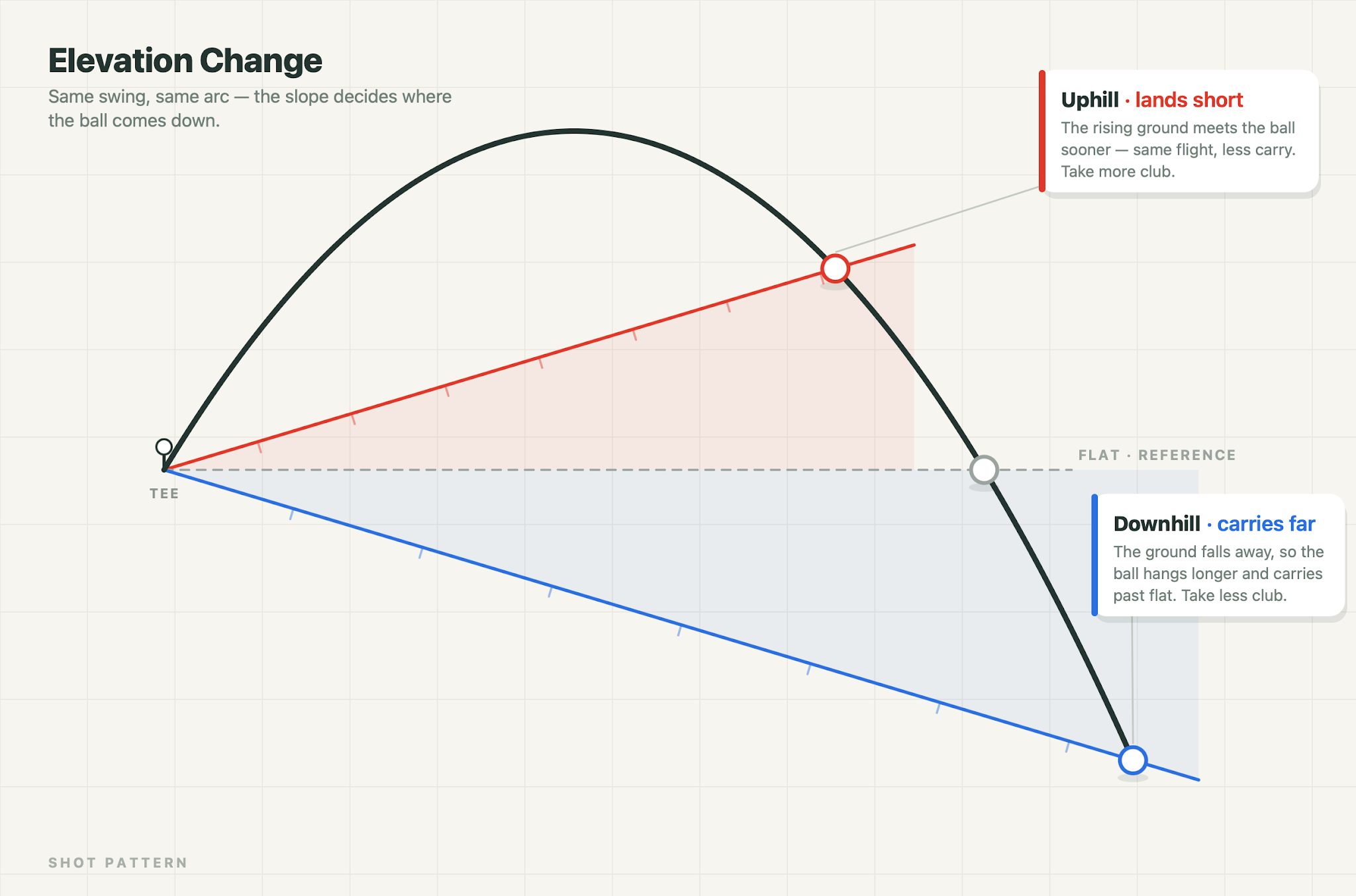**
This one is pure geometry. Uphill, the ground gets in the way earlier than it would for a flat shot. Downhill, you've got more hang time before the ball touches down.
**Baseline: about one yard of distance adjustment per yard of elevation change.** A green 10 yards above you plays roughly 10 yards longer. A green 3 yards below you plays about 3 yards shorter.
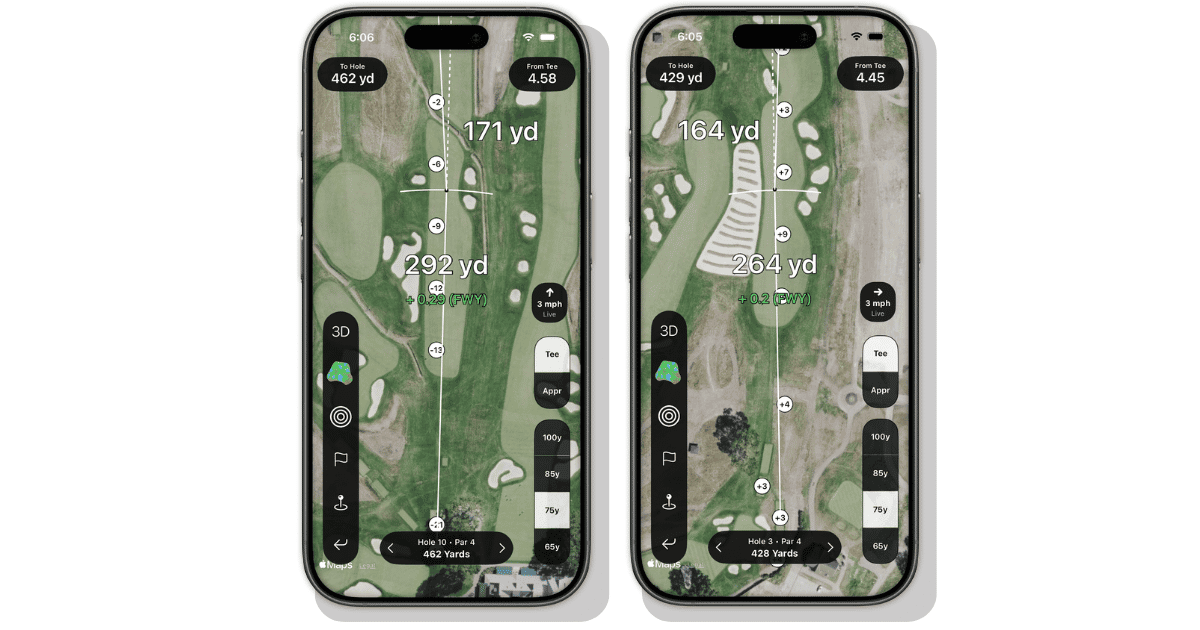
These numbers apply to carry distance. Uphill shots tend to roll out more than usual because the ball’s descent angle is flatter ([Titleist](https://www.titleist.com/learning-lab/performance/golf-ball-angle-of-descent?srsltid=AfmBOoqPg1RuAiduBp4-9PYrjH7WS7mid5AOZwFsqqBeuMkr_WM8YRlk)). Downhill shots stop more quickly because the descent angle steepens relative to the slope. The carry math is close to one for one, but the total distance picture has more nuance depending on [the terrain you’re working with](https://shotpattern.app/blog/4-things-to-check-in-3d-course-preview). Which is one reason [green contour data](https://shotpattern.app/blog/green-maps-purpose)matters when you're planning an approach
## **Wind: It Hurts More Than It Helps**
Most golfers treat headwinds and tailwinds as mirror images. They’re not. A headwind costs you roughly twice as much distance as a tailwind gives back.
**Baseline (TrackMan): into a headwind, add about 1% of your distance per mph of wind. Downwind, subtract about 0.5% per mph.** A 150 yard shot into 10 mph of wind plays like about 165. That same 150 with 10 mph behind you plays like roughly 143. Same wind speed, very different numbers.
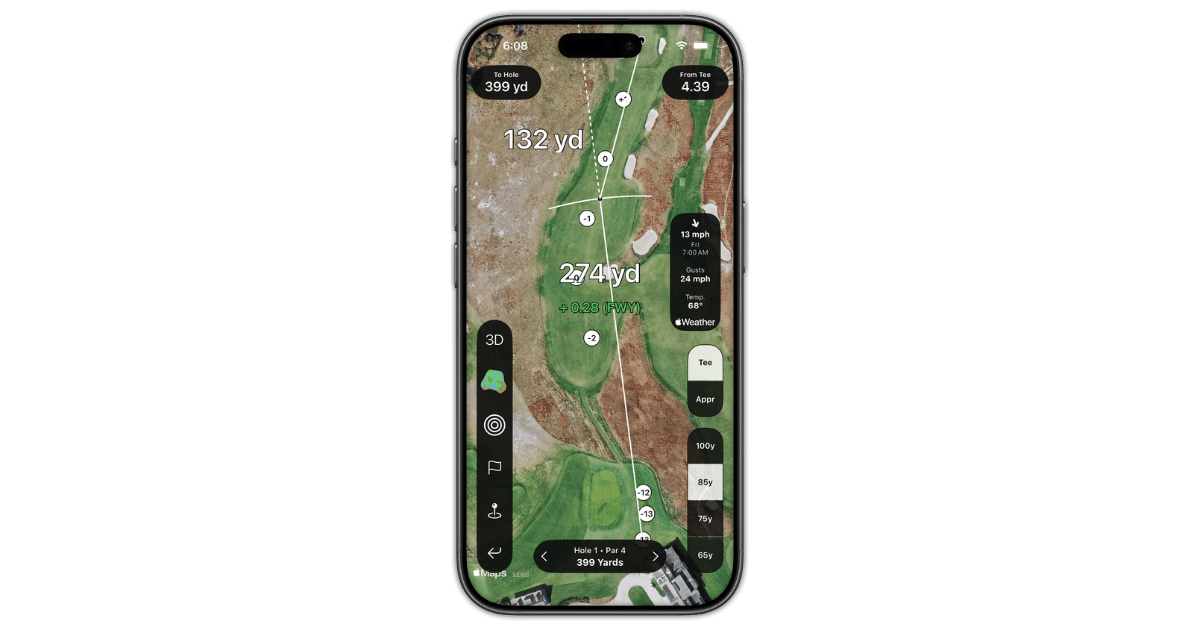The math on that headwind example: 1% per mph means 10 mph adds 10% to your distance. 10% of 150 is 15 yards, so 150 becomes 165. Downwind, 0.5% per mph means 10 mph subtracts 5%. 5% of 150 is about 7 yards, so 150 becomes 143.
How much wind actually affects your ball depends heavily on your launch conditions. Players who hit it high with a lot of spin will see a bigger effect than players who keep the ball low. There’s no way to generalize that part with a single number. If you have access to a TrackMan or a simulator with a wind function, spending time experimenting with different wind speeds will teach you more about your own numbers than any formula on a page. Once you know your adjustments, you can fold them into a [pre-round game plan](https://shotpattern.app/blog/how-to-create-a-game-plan-before-your-next-golf-tournament).
## **Putting It All Together**
150 to the pin. 50°F. Into 10 mph of wind. Green sitting 5 yards above you. Altitude is already baked into your stock numbers if you traveled, so it stays out of this math.
Start at 150. Temperature: cold air adds about 2, so call it 152. Elevation: 5 yards uphill puts you at 157. Wind: 10% of the original 150 is 15 yards, bringing you to 172. Your 150 yard look is really a 170 plus shot.
When you combine these adjustments with [strokes gained data from your rounds](https://shotpattern.app/blog/what-is-strokes-gained), you start to see exactly where misreading conditions is costing you.
One variable at a time, small running total. The baselines are simple enough to carry with you: about 1.2% per 1,000 feet of altitude, one yard per yard of elevation change, 1% per mph into the wind and half that downwind, and about 1.5% per 20°F of temperature. Adjust them to your own game over time, keep a running total, and trust the math over your eyes. The most reliable plays like calculator you own is the one between your ears. And once the skill is yours, nobody can take it away from you on the first tee.
Shot Pattern gives you the raw inputs for every calculation above. GPS yardages, elevation markers down each hole, the wind meter with forecasted speed and direction, and [green maps with contour data](https://shotpattern.app/blog/green-maps-purpose) are all tournament legal and available during any round. What we deliberately don’t do is hand you the final number, because [the rules don’t allow it in competition](https://shotpattern.app/blog/how-to-create-a-game-plan-before-your-next-golf-tournament) and because I’d rather you owned the math.
Practice the adjustments during your casual rounds, and they’ll be second nature when the round counts.
## Frequently Asked Questions
How do you calculate plays like distance in golf?
Start with your stock carry number. If you traveled to a different altitude, reset it first at about 1.2% more carry per 1,000 feet of gain over your home course. Then on each shot, adjust for elevation change (about one yard per yard), wind (add roughly 1% per mph into a headwind, subtract about 0.5% per mph downwind), and temperature (about 1.5% per 20°F off a 70° baseline, adding yardage when it’s colder). Stack the adjustments into a running total and club accordingly.
Can you use plays like distance in a golf tournament?
No. The Rules of Golf don’t permit a calculated plays like distance or a club recommendation during competition, and they shouldn’t be used for rounds that count toward your handicap either. Raw GPS yardages, elevation data, wind forecasts, and green maps are generally permitted, which is why learning to make the adjustment yourself matters. Always check the specific rules for any event you play.
What is the difference between altitude and elevation change in golf?
Altitude is how high the course sits above sea level. It adds carry to every shot because the air is thinner, and you handle it once by resetting your yardages when you travel. Elevation change is the uphill or downhill difference between you and the target on a single shot, handled shot by shot at about one yard per yard. Same word in everyday use, two different adjustments on the course.
How much does cold weather affect golf distance?
Per [Titleist](https://www.titleist.com/learning-lab/performance/temperature-and-golf-ball-performance), you lose roughly 1.5% of carry for every 20°F drop below a 70°F baseline, since denser cold air adds drag. That works out to about 5 yards on a 300 yard drive between 75° and 55°. On a cold day, a chilled ball and a restricted swing add more on top of the air density effect, and the real world loss can approach a full club.
## Share this post
[mailto:https%3A%2F%2Fshotpattern.app%2Fblog%2Fplays-like-distance](mailto:https%3A%2F%2Fshotpattern.app%2Fblog%2Fplays-like-distance)
## Keep reading
### [ Print Your Own Yardage Book](https://shotpattern.app/blog/print-your-own-yardage-book)
### [ How to Use ChatGPT to Analyze Your Golf Stats | Shot Pattern](https://shotpattern.app/blog/use-ai-to-lower-golf-scores)
[](https://shotpattern.app)
---
[Terms of Use](https://shotpattern.app/terms-of-use) · [Privacy Policy](https://shotpattern.app/privacy-policy) ·[Support](https://shotpattern.app/support) · [Help Center](https://shotpattern.app/help)
© 2026 Undaunted Athlete, LLC. All rights reserved.
```json
{
"@context" : "https://schema.org",
"@type" : "BlogPosting",
"author" : {
"@type" : "Person",
"name" : "Eric Duffett",
"url" : "https://shotpattern.app/blog/author/eric-duffet"
},
"dateModified" : "2026-08-27T21:30:06.188Z",
"datePublished" : "2026-06-25T23:26:00.000Z",
"headline" : "How to Calculate Plays Like Distance in Golf ",
"image" : [ "https://shotpattern.app/hubfs/shot-pattern-plays-like-distance-golf-course-management.png" ],
"mainEntityOfPage" : {
"@id" : "https://shotpattern.app/blog/plays-like-distance",
"@type" : "WebPage"
},
"publisher" : {
"@type" : "Organization",
"logo" : {
"@type" : "ImageObject",
"url" : "https://shotpattern.app/hubfs/Circle%20Logo%20-%20No%20Background%20-%20Most%20Used.png"
},
"name" : "Shot Pattern"
}
}
```
```json
{
"@context" : "https://schema.org",
"@type" : "FAQPage",
"mainEntity" : [ {
"@type" : "Question",
"acceptedAnswer" : {
"@type" : "Answer",
"text" : "Start with your stock carry number. If you traveled to a different altitude, reset it first at about 1.2% more carry per 1,000 feet of gain over your home course. Then on each shot, adjust for elevation change (about one yard per yard), wind (add roughly 1% per mph into a headwind, subtract about 0.5% per mph downwind), and temperature (about 1.5% per 20°F off a 70° baseline, adding yardage when it's colder). Stack the adjustments into a running total and club accordingly."
},
"name" : "How do you calculate plays like distance in golf?"
}, {
"@type" : "Question",
"acceptedAnswer" : {
"@type" : "Answer",
"text" : "No. The Rules of Golf don't permit a calculated plays like distance or a club recommendation during competition, and they shouldn't be used for rounds that count toward your handicap either. Raw GPS yardages, elevation data, wind forecasts, and green maps are generally permitted, which is why learning to make the adjustment yourself matters. Always check the specific rules for any event you play."
},
"name" : "Can you use plays like distance in a golf tournament?"
}, {
"@type" : "Question",
"acceptedAnswer" : {
"@type" : "Answer",
"text" : "Altitude is how high the course sits above sea level. It adds carry to every shot because the air is thinner, and you handle it once by resetting your yardages when you travel. Elevation change is the uphill or downhill difference between you and the target on a single shot, handled shot by shot at about one yard per yard. Same word in everyday use, two different adjustments on the course."
},
"name" : "What is the difference between altitude and elevation change in golf?"
}, {
"@type" : "Question",
"acceptedAnswer" : {
"@type" : "Answer",
"text" : "Per Titleist, you lose roughly 1.5% of carry for every 20°F drop below a 70°F baseline, since denser cold air adds drag. That works out to about 5 yards on a 300 yard drive between 75° and 55°. On a cold day, a chilled ball and a restricted swing add more on top of the air density effect, and the real world loss can approach a full club."
},
"name" : "How much does cold weather affect golf distance?"
} ]
}
```